Lekki Arts and Crafts Market
The one souvenir market everyone in Lagos gets sent to — masks, textiles, drums, beads and paintings under one long corrugated roof.
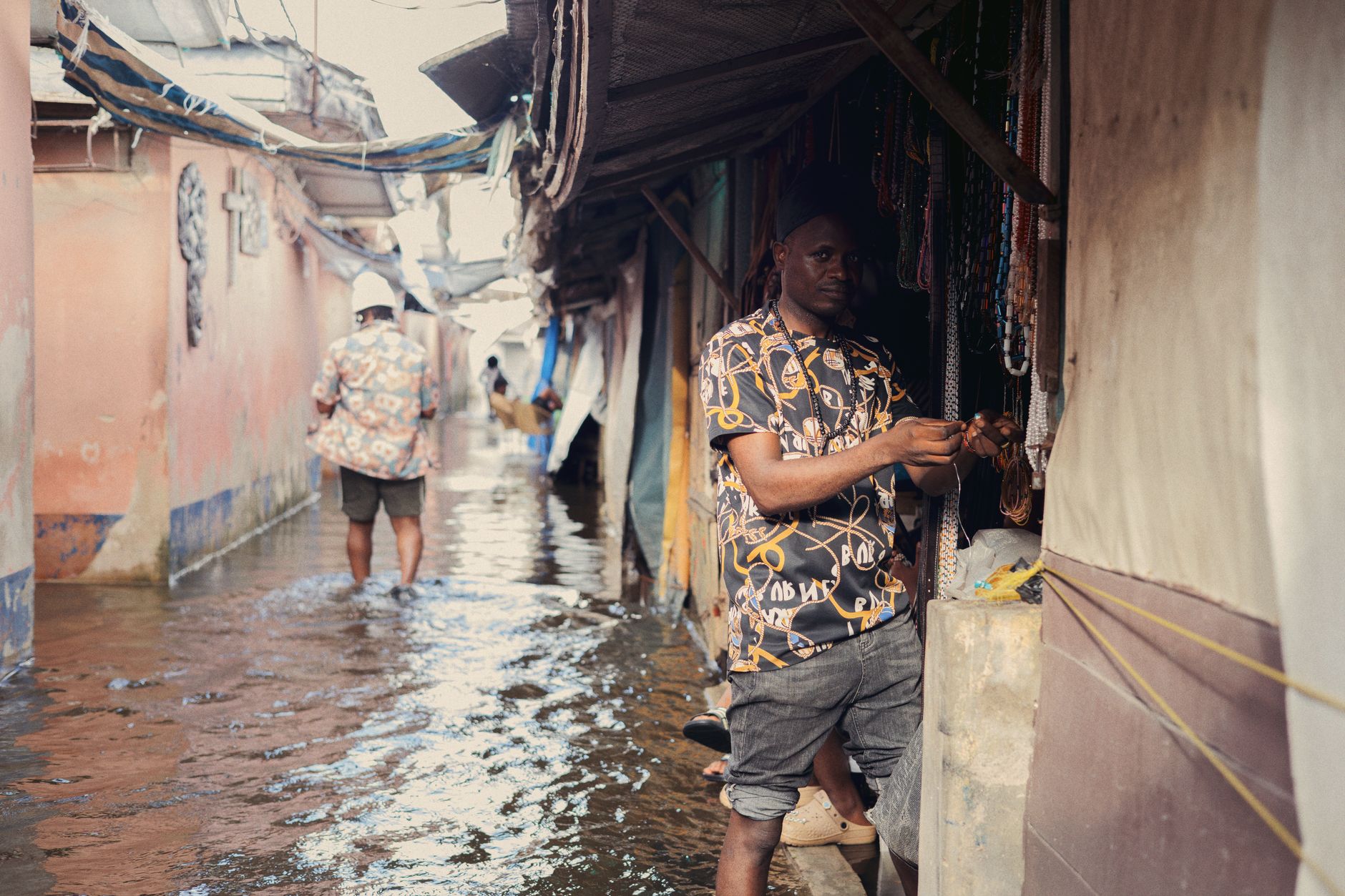
The Lekki Arts and Crafts Market (also called Jakande Market by taxi drivers) is the covered handicraft market that sits just off the Lekki-Epe Expressway a minute's drive from Lekki Phase 1 roundabout. It is not a food market or a fashion market — it is specifically the place where hand-carved masks, Yoruba textiles, adire cloth, Benin bronzes, Fulani leather, wooden drums, beads and West African paintings are sold. It is where anyone visiting Lagos ends up when they need to bring something home.
The stalls are organised loosely by category. Textiles are toward the front — bolts of adire, kente, ankara, and Aso Oke — with tailors on site who can turn a length of cloth into a shirt in 24 hours. Masks and carvings fill the middle rows. Beads, jewellery and small souvenirs are near the back. Sellers are used to tourists and will start prices at three to four times the real rate; comfortable haggling is expected and enjoyed. Prices in dollars are quoted freely but you can pay in naira with a better rate.
Come on a weekday afternoon when the aisles are quiet enough to actually browse; Saturdays are crowded and hot. Bring cash and a bag. Do not buy the first piece you like — walk the whole market, note prices at three stalls, then come back. If you commission a tailored shirt, agree the pickup time in writing. Combine with Nike Art Gallery ten minutes east for a full culture morning.
Physically the place is one long shed: a concrete apron, a corrugated iron roof on steel posts, and parallel rows of lock-up stalls barely two metres wide, each one crammed floor to ceiling. The front textile rows smell of indigo and starch, and the tailors sit at treadle machines between the bolts, measuring on the spot. The carving rows are darker and denser — Gelede masks, ibeji twin figures, brass Benin-style heads, terracotta pieces in the Nok style, stools and salad spoons by the crate. Behind them come Hausa and Fulani leather (camel-hide bags, sandals, unstuffed pouffe covers), then the drums: gangan talking drums, djembes, shekere gourd rattles. Paintings are stacked unframed against the back walls. Buy canvases rolled rather than stretched — they go flat in a suitcase — and leave drums until last, because once you are carrying one nobody takes your bargaining seriously.
Getting here is simple by road and miserable in traffic. From Victoria Island a Bolt, Uber or inDrive ride costs roughly $3-$6 and takes 15-30 minutes off-peak, crossing either the Lekki-Ikoyi Link Bridge or Falomo Bridge; car tolls on that route run about $0.20-$0.25 a crossing. From Ikeja and Murtala Muhammed Airport budget $18-$30 and 60-120 minutes depending on the hour. Yellow danfo buses and the blue Lagos Bus Services coaches running the Ajah-Obalende corridor stop at Lekki Phase 1 roundabout for well under $1; from there it is a three-minute walk 200 m east along the north service lane. Tell any driver "Jakande Market" — the official name draws blank looks. There is an unpaved car park on site; tip the attendant about $0.50. Avoid arriving between 16:00 and 20:00, when the expressway seizes solid.
Nothing is charged at the gate and there is no ticket booth, so ignore anybody who invents a market fee. Inside, a realistic haul looks like this: waist beads and small strings $2-$5, a medium carved mask $15-$40, adire by the metre $10-$25, a talking drum $25-$60, a brass Benin-style head $30-$120 by size and weight, an unframed canvas $20-$80, a leather pouffe cover $20-$40. Tailoring labour on a shirt runs about $15-$30 on top of the cloth. Bring naira cash in mixed notes — card machines exist at a handful of stalls but fail whenever the network drops, and the nearest reliable ATMs are on Admiralty Way, about five minutes back west. Budget $50-$100 and you will leave with a bagful; budget $20 and you will still leave with something.
The market runs daily 9:00-19:00, but the practical window is narrower. Stalls unlock properly around 10:00 and start shuttering as the light goes near 18:30. Tuesday to Thursday between 10:00 and 15:00 is the quiet stretch, when a trader will sit with you and actually move on price. Saturday afternoons are packed and airless under the iron roof. Sundays start late — many traders come after church, so before noon half the aisles are padlocked. Seasonally, November to February is the pick: dry, breezy, harmattan haze keeping the heat down. March and April are brutal under that roof by midday. June and July bring the heaviest rain, which the roof handles but the approach lane and car park do not, and the noise makes haggling a shouting match. In the last three weeks of December, diaspora crowds arrive and opening prices harden noticeably.
It suits anyone with a shopping list and an appetite for negotiation, and it suits a rainy afternoon better than most Lagos outings because almost everything is roofed. It suits a one-hour gap too: 40 focused minutes is enough for one considered purchase if you enter knowing what you want. It suits families with older children less well than parents hope — the aisles are too narrow for a pushchair, the floor is uneven concrete and sand, there is no accessible toilet, and wheelchair users will find the side rows effectively closed. Teenagers last about half an hour unless you hand them the bargaining. Skip it if you dislike being called to constantly, or if you came for food, groceries or fashion — that is not what is sold here. With a half-day, pair it with Nike Art Gallery (10 minutes east, free), The Palms Shopping Mall (5-10 minutes, ATMs and a food court) or the 401 m canopy walkway at Lekki Conservation Centre, 20-30 minutes further east.
Two things are oversold. First, age: almost nothing here is antique, whatever the patina suggests. The brass heads are modern casts, the "old" masks are usually months old and smoke-darkened, and genuine antiquities cannot legally leave Nigeria without a permit from the National Commission for Museums and Monuments — so treat every antique claim as sales patter and pay for the object you like, not the story attached to it. Second, guiding: men will attach themselves at the car park offering to show you around and take a cut of whatever you buy. Either decline firmly at the entrance or agree $2-$3 up front and hold them to it. Also expect the price to jump the moment you show real interest; walking two stalls down and returning ten minutes later is the single most effective move you can make here.
Hours & entry
Daily 9:00-19:00
What to see
{'what': 'Adire indigo textiles', 'where': 'First two rows on the left as you enter'}
{'what': 'Yoruba carved masks', 'where': 'Central aisle, stalls 30-50'}
{'what': 'Beadwork and Fulani jewellery', 'where': 'Back left corner, near the exit to the car park'}
Tips from the ground
Start bargaining at 30% of the asking price — final settles around 50%
Take a photo of anything you might come back to; the aisles all look alike
Ask a friendly stallholder for the tailors' section — they are tucked in the back
Questions, answered
How much does the market cost?
Free to enter. Prices inside vary — small beads $2, medium mask $15-$40, adire cloth $10-$25 a metre. Add roughly $25-$60 for a talking drum, $30-$120 for a brass Benin-style head, $20-$80 for an unframed canvas and $15-$30 in labour for a tailored shirt on top of the cloth. Opening quotes run three to four times the real rate, so start at 30% and expect to settle near half. Bring naira cash in mixed notes; stall card machines fail whenever the network drops.
Are there free entry hours?
All hours are free. There is no ticket booth, no gate charge and no timed entry at any point of the day, so anyone asking for a market fee at the car park is freelancing — walk past. The only unavoidable extras are small ones: about $0.50 to the parking attendant, a token coin for the basic toilets, and $2-$3 if you choose to accept one of the informal guides who offer to walk you round. Declining them at the entrance is perfectly normal here.
How long should I plan?
1-2 hours to browse, 3 hours if you commission a tailor piece. Forty minutes is enough if you arrive with a specific list and are willing to bargain fast. Add driving time honestly: 15-30 minutes each way from Victoria Island off-peak, far more if you leave after 16:00. Tailoring usually means returning the next day, so measure early in your trip. Most visitors fold the market into a half-day with Nike Art Gallery, ten minutes east.
When is it closed?
Open daily. A few stalls shut on Sundays but the market functions. In practice Sunday morning is the thinnest session, with traders arriving after church and many shutters still down before noon. Public holidays such as Christmas Day, New Year's Day and the Eid days leave large gaps in the rows. Rain closes nothing but empties the aisles and makes the iron roof deafening. Traders unlock properly around 10:00 and begin packing before the 19:00 close, so aim for 10:00-15:00.
Do I need to book?
No booking. Just walk in. There are no tickets, tours or timed slots to reserve, and no operator sells guided access worth paying for. The one thing that needs arranging in person is tailoring: give your measurements, agree the price and put the pickup time in writing before you hand over cloth. If you are buying something bulky like a drum or a stool, settle the packing on the spot too, and keep your ride-hail driver's number so you are not carrying it to the roundabout.
What is the nearest stop?
Lekki Phase 1 roundabout on Lekki-Epe Expressway; the market entrance is 200 m east on the north side. Danfo buses and the blue Lagos Bus Services coaches on the Ajah-Obalende corridor stop at the roundabout for well under $1, leaving a three-minute walk. Ride-hailing from Victoria Island costs about $3-$6 and takes 15-30 minutes off-peak; from Ikeja or the airport, $18-$30 and up to two hours. Say "Jakande Market" to your driver — the official name is rarely recognised.
Doing good is the business: every booking through Stay Lekki funds one verified tonne of carbon removal — same room, same price, no markup.
Start Your Search